This article is not "what is a white page and 9 ways to make one." That's been written six times over. It's about how Facebook and Google moderation is actually built in 2026, why old whites no longer survive, and what to do about it in practice — from the structure of a single page to running an operation across dozens of geos.
Disclaimer. This material is educational and describes industry practices as they are discussed in open sources. We are not encouraging anyone to violate ad-network rules — the decision and the responsibility always sit with the media buyer.
Quickly: what a white page is and where it sits in the funnel
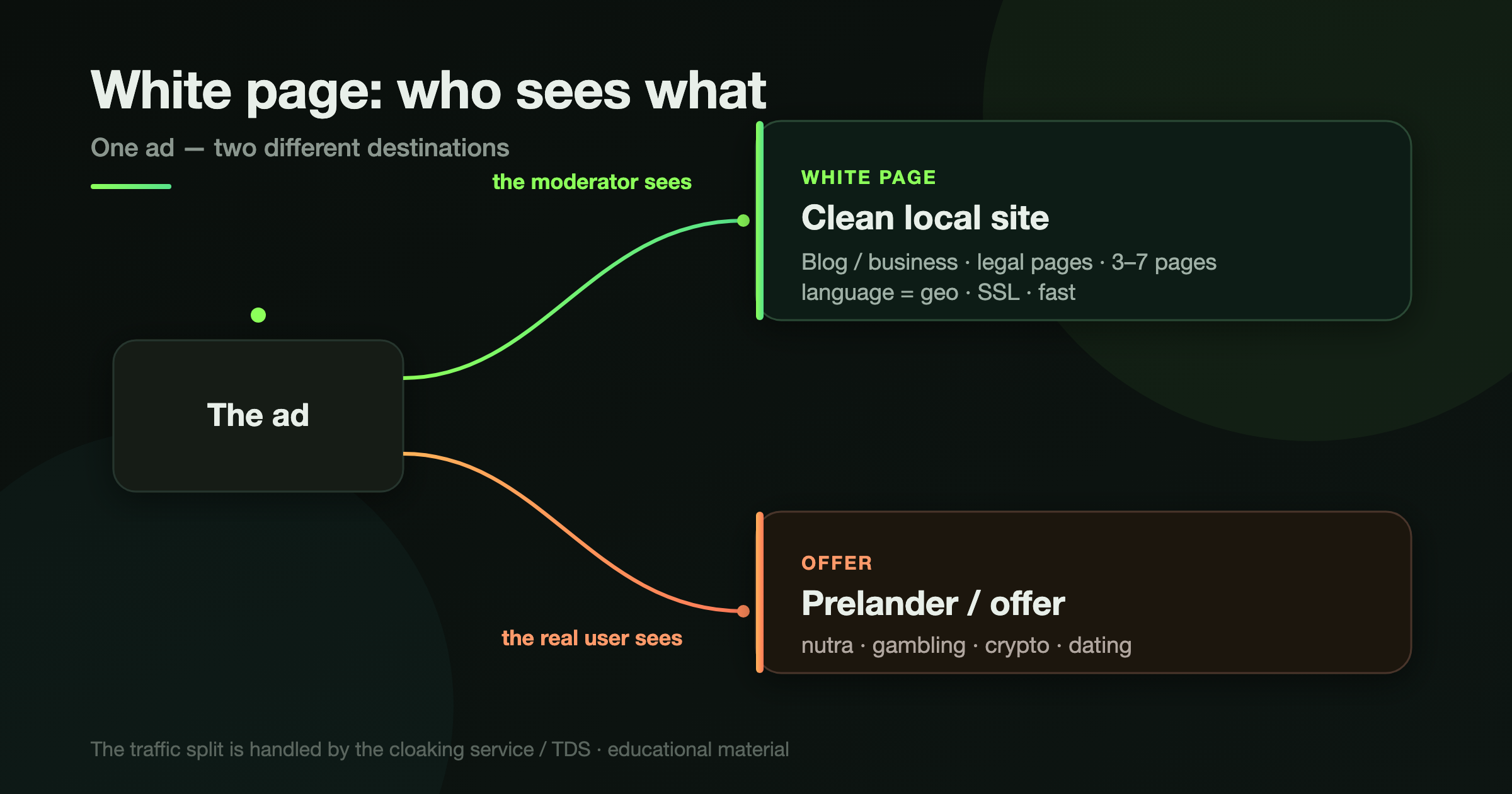
Let's move fast here, you already know this. A white page (the "white") is the clean, safe version of a site shown to the ad network's moderation system. After the click, the real user lands on different content — a prelander or the offer (that split is the job of the cloaking service / TDS). The point is that verticals which don't pass on direct advertising (nutra, gambling, crypto, finance, dating) need a "wrapper" that moderation reads as an ordinary, legitimate site.
The key thing people get wrong: a white page is built to match the creative, not the offer. The moderator sees exactly what's in your ad. If the creative is a fitness blog, the white must be a believable fitness blog. This is called "indirect relevance": a theme close to the creative, but not the product itself.
Now the part this article is actually about.
How moderation actually catches you in 2026
The core mistake in old guides is the assumption that there's one "moderation bot" with a fixed user-agent, and if you recognize it and serve it the white, you're safe. In 2026 this fails for several reasons at once.
Facebook / Meta: they review the connection, not the ad
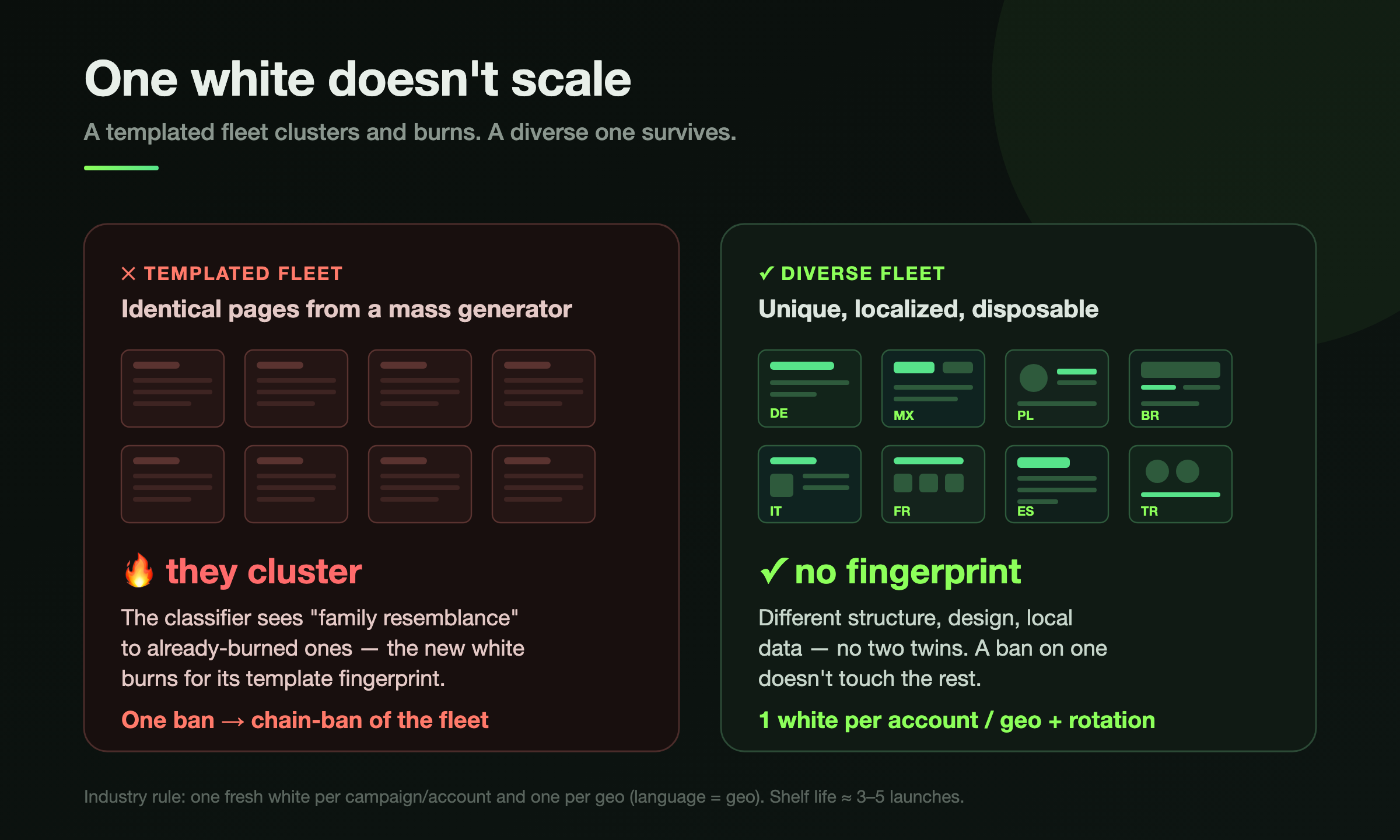
Meta runs every ad through automated classifiers before the first impression — which, by the way, is not a "2026 breakthrough" the way some blogs frame it; it's been the mechanic for years. What changed is the depth of the check. The system no longer looks at the text, the image and the page in isolation — it looks at the connection between them and at the account's history:
- The landing page is officially part of the review. The destination page, redirects, first screen and disclaimers are all assessed. A mismatch between the promise in the ad and what's on the page (landing page discrepancy) is a common rejection reason.
- Semantic linking. The classifier catches meaning, not a banned word. "Lose 8 kg in a week" plus a before/after photo reads as a false transformation claim, even with zero stop-words.
- Account history. Behavior (a sudden jump into Ads Manager on a fresh profile), device fingerprint, payment patterns, cross-account links via a shared IP/fingerprint — all of it carries weight in the decision.
"Second moderation" — this is why the white dies on day three
The single most important and least-covered point. Passing review on day zero guarantees nothing. The industry consistently reports re-checks of already-running ads: the system comes back to the approved creative a day or two later and re-verifies the creative↔page connection with a fresh pass. That's where the classic "the white lived 2 days and died" pattern comes from — nobody "reported" it, it got re-moderated.
The practical takeaway: a white must survive not one pass but a series of checks across the entire life of the campaign. A one-off "placeholder" that passes at launch is, in 2026, a ticket to a day-three ban.
Google: here, the real user is looking too
Google has its own specifics, and they're harsher in consequences. What the crawler sees and what people see are tracked in parallel:
- Googlebot vs. samples. Google compares the content its crawler recorded against what's visible through other channels. Per industry reporting, that means residential proxies and internal monitoring (Google doesn't disclose the details officially, so treat this as an industry model, not a document).
- Real-user telemetry. Through aggregate Chrome Safe Browsing data, Google knows what people actually saw after clicking the ad. If that diverges from what the crawler saw — that's a trigger for manual review. This is almost impossible to "filter by IP," because these are real users.
- "Report an ad" complaints feed the same system.
And two things Google punishes completely differently — memorize this:
| Violation | Penalty |
|---|---|
| Destination mismatch (display-URL domain doesn't match the final URL, redirects to a different domain, a tracking template that doesn't lead to the final URL) | "Soft." A warning at least 7 days before suspension, with time to fix and appeal. |
| Cloaking (the "Circumventing systems" policy) | Hard. "Accounts will be suspended upon detection without prior warning, and you will not be allowed to advertise." Effectively a lifetime ban. |
There's also a risk Facebook doesn't have: the same company owns both ads and organic search. The blunt claim that "cloaking on Ads kills your organic" is an overstatement (they're separate enforcement systems), but the same behavior can independently trigger a manual action in Search and tank the domain's SEO rankings. That's why trusted brand sites are never used for cloaking.
Why the AI-generated white burns: the template fingerprint
Here's the 2026 paradox nobody writes about while recommending "generate a white in 15 minutes in a bot."
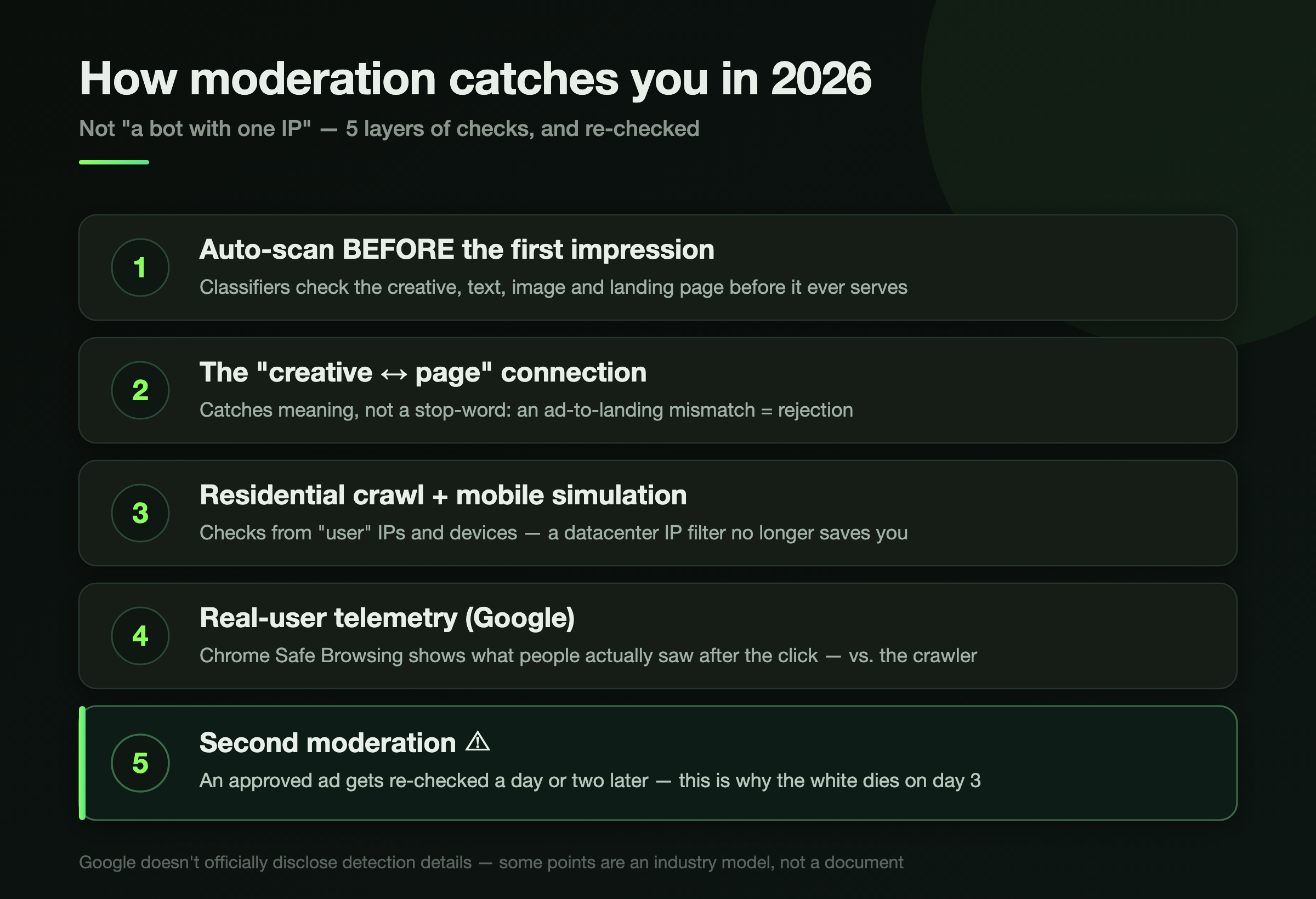
AI moderation now burns templated and empty pages on sight. An empty template, Lorem Ipsum, a one-to-one copy — instant signal. But the problem runs deeper: most popular generators produce structurally similar pages at scale. Classifiers are getting better and better at clustering that output — that is, recognizing "this was made by the same generator as another thousand already-burned whites." Your new page burns not because of its content, but because of its family resemblance to already-banned ones.
What to do about it:
- Unique structure, not identical. Different block order, different design systems, different class and file names — so two of your pages don't read as twins.
- Real images and local-business specifics, not stock placeholders and abstractions.
- Genuine localization: language = geo, local phone and address, local details. Full breakdown: geo localization →
This is exactly why what you generate with matters. A generator that stamps out 1,000 identical one-pagers is a fingerprint factory for clustering. A generator that produces a structurally unique, multi-page site per domain with real geo data and varied templates (for example, white-lands builds every lander with a randomized structure, a separate design system, and local data for 100+ geos and languages) is a different grade of "whiteness." The point isn't that "the page is prettier" — it's that it doesn't match the fleet of already-burned ones.
Anatomy of a live white page in 2026
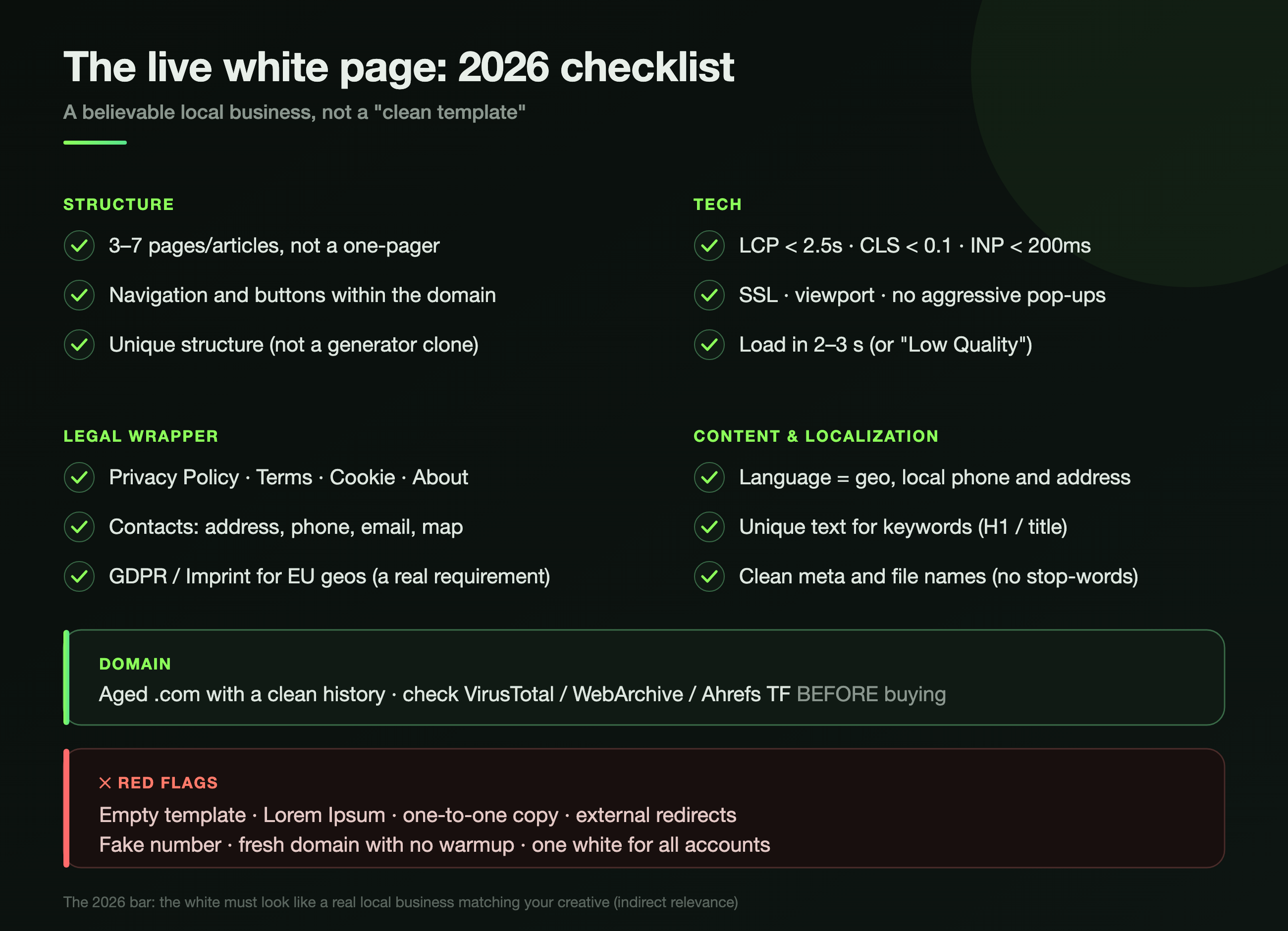
The quality bar shifted from "clean template" to "believable local business." The winner isn't an abstract landing page — it's a site that looks like a real Berlin plumber, a Mexico City yoga studio, or a Warsaw florist, with articles, images, working navigation and a full legal set. Here's the concrete spec:
Structure (mandatory markers of a live site):
- 3–7 pages / articles, not a one-pager. A multi-page site with working internal navigation is a baseline "live site" signal.
- Every button leads to pages within the same domain. External redirects are both a mismatch and a substitution signal.
Legal "wrapper" (mandatory):
- Privacy Policy, Terms of Service, Cookie notice, Contacts (address, phone, form, email on the domain, ideally a map), About.
- For EU geos, Privacy Policy and cookie consent aren't "for show" — they're real GDPR requirements; Imprint for DE, etc. This is legal protection and a legitimacy signal at once.
**Technical quality (this *is* the Landing Page Experience that raises your Google Quality Score):**
- Core Web Vitals: LCP < 2.5 s, CLS < 0.1, INP < 200 ms (don't confuse this with the old FID 100 ms — FID was replaced by INP back in March 2024).
- Load time 2–3 s, or you risk a "Low Quality Ad."
- Mobile responsiveness with a correct viewport.
- SSL, always.
- No aggressive interstitials/pop-ups that trigger a page-experience penalty.
Content and hygiene:
- Unique text relevant to your keywords (H1, meta title and body match the ad's target keywords).
- Meta tags and file names scrubbed of stop-words — brands, "earnings," medical terms.
- Text language = geo language; local phone and address for the country.
How many whites you need, and how not to burn the whole fleet
Here's what no competing article covers: a white page is not a file, it's an operation.
The baseline rule the industry agrees on: one fresh white per campaign / account and one per geo (because the page language has to match the geo language). The logic is simple — so that one burned profile doesn't drag the rest down in a chain. If you run 15 accounts across 8 geos on the same white on one domain, you're not diversifying risk, you're concentrating it.
What this means in practice:
- Domains. An aged domain (aged .com with a clean history) passes review faster than a fresh one — for Google that's 1–2 days vs. a longer cool-down for a new domain; for Meta an aged domain lives noticeably longer, per industry data. Always check the history BEFORE buying — VirusTotal, WebArchive, backlink profile (Ahrefs / Majestic TF). A domain with a spammy past or sanctions is negative trust before you even start.
- Fingerprint isolation. Different whites on different domains, ideally with separated hosting/fingerprint, so a ban on one doesn't produce cross-account linking to the rest.
- Rotation. One white's shelf life is roughly 3–5 launches, then replace it. Treat whites as a versioned fleet, not one eternal file.
This is where manual work stops scaling. Building 5 unique multi-page whites across 5 geos with different languages, local data and domains is days of work by hand. So buyers at scale move to generation — but (see the section above) it's essential that the generator outputs unique, not cloned pages. white-lands, for instance, covers exactly this scenario: a pack of landers across different geos/languages/domains in a single session, each structurally different. The point isn't the specific service, it's the principle: the fleet of whites must be diverse, localized and disposable.
Verification and warmup: the 2025–2026 entry barrier
Even a perfect white won't save you if the account itself burns. In 2025–2026 both platforms sharply raised their requirements for the advertiser's identity.
- Advertiser verification. Google made two-step identification mandatory: business registration / tax forms / government ID with a legal name and address, address confirmation, a photo of the document. Miss the deadline and the account is paused. Meta is also actively expanding verification and publicly aims for most ad revenue to come from verified advertisers.
- Phone. The number must be verified, active and local to the geo. Fake / premium-rate / vanity numbers get blocked.
- Account warmup. A fresh account that jumps straight into Ads Manager with a big budget gets disabled "within hours." Industry practice: 7–14 days of organic activity (for Google usually 10–14, for Facebook 7–10) before the first launch; start at $5–10/day; scale no more than ~20% per step. Practitioners report that deep warmup (20+ days) multiplies account lifespan and noticeably cuts bans.
- Infrastructure. Residential proxies matched to the geo, an antidetect browser (Multilogin, Dolphin Anty, Octo), separated fingerprints. A test card transaction a week before launch.
- Agency vs. farmed accounts. Agency accounts (high trust, no spend cap) are rarely banned for content — but cost 10–20% of spend. Farmed accounts are cheap but burn, and don't survive without cloaking + antidetect + proxies. The choice is a risk/margin tradeoff, not a "which is better."
Verticals: where direct advertising works, and where the gray zone starts
- Gambling. Since July 8, 2025, gambling ads in Meta require mandatory authorization via Business Suite (Permissions & Verifications): you declare the type (operator / aggregator / affiliate), provide a license, a partnership document, company details, the lander URL and a list of all ad account IDs. Plus a list of prohibited geos. Licensed operators can go direct; affiliates are almost always in the gray zone.
- Crypto and finance. Allowed only via official permission (Authorizations & Verifications) with proof of licensing; guaranteed/risk-free income claims are prohibited; credit offers fall under a special ad category with targeting restrictions. (Careful with the myths: loud "facts" about a crypto targeting ban under 25, a "Verified Crypto Advertiser" badge, or "38 verification countries" circulate on SEO blogs but do not exist in Meta's official standards — don't build a strategy on them.)
- Nutra / dating. The classic gray zone. And even on a "white" creative, nutra gets clipped by the personal-attributes rules: conditional phrasing ("If you've been diagnosed with…"), empathy hooks and implied targeting are banned, and "product + photo of a healthy person" can be read as a hidden before/after.
- AI content. Disclosure of AI media is becoming mandatory; Meta detects synthetic media via metadata (C2PA/IPTC) and applies a label. Undisclosed AI content is a rejection reason. This applies to creatives and, potentially, to images on the white itself.
7 mistakes that get you banned
- Picturing moderation as "a bot with an IP." In 2026 it's residential crawling + mobile simulation + ML + real-user telemetry + re-checks. An IP filter screens out the datacenter bot, but not a human moderator on a residential IP.
- A one-off placeholder white. Passes at launch, dies on the "second moderation" on day 3.
- A templated white from a mass generator. Clusters together with the already-burned fleet.
- One white across all accounts and geos. One ban drags the rest along in a chain.
- A fresh domain + a gray lander with no warmup. In 2025–2026 that's an almost guaranteed ban.
- A sharp budget jump on a young account — a classic trigger.
- Broken buttons, external redirects, slow loading, a fake number — each on its own is already a substitution or low-quality signal.
FAQ
Why does the white die on day three even though it passed review? Because of re-moderation: the system re-checks already-running ads with a fresh pass a day or two later. Passing on day zero guarantees nothing — the white has to survive a series of checks.
How many white pages do I need? Rule of thumb: one fresh white per campaign/account and one per geo (because language = geo). It diversifies risk — one ban doesn't take down the whole fleet.
How is cloaking different from destination mismatch in Google? Destination mismatch is a "soft" violation: a warning at least 7 days out and a chance to fix. Cloaking (Circumventing systems) is a suspension with no warning and a lifetime advertising ban. Different leagues.
Can I use one white for several campaigns? Technically yes, the shelf life is roughly 3–5 launches, but it raises chain-ban risk. Safer: a separate white per domain/account/geo, plus rotation.
Is an AI white-page generator bad? Not the AI itself — the templating. A generator that outputs identical pages creates a fingerprint for clustering. You need output with genuine structural uniqueness and geo localization.
How many pages should a white have? 3–7 pages/articles with working internal navigation and a full legal set (Privacy, Terms, Cookie, Contacts, About). A one-pager reads as a placeholder.
Conclusion
In 2026 the white page stopped being "a file that passes moderation." It's now an operation: a believable local site with real structure and a legal set, unique against the fleet, localized to the geo, on an aged domain with a clean history, paired with a warmed, verified account — and disposable by design. Moderation looks at the "creative ↔ page ↔ account ↔ what the user actually saw" connection, re-checks, and clusters templates. Those who get this build a fleet of diverse, localized whites and rotate it. Those who don't keep thinking "the accounts are just bad."
If you build whites at scale, what matters isn't generation speed — it's that each page is structurally unique, genuinely localized to its geo, and lives on its own domain. The tools exist (white-lands, for one, generates packs of such landers across 100+ geos and languages) — but the principle beats any specific service: a diverse, localized, disposable fleet beats one "perfect" white every time.